
The Discourses on Arts and Sciences
The Social ContractThis flow follows the first Discourse’s polemical case that cultural refinement can conceal moral weakness and increase dependence.
increasing Bearing strength in each event
 decreasing
Bearing strength in each eventdecreasingThe Question at Dijon
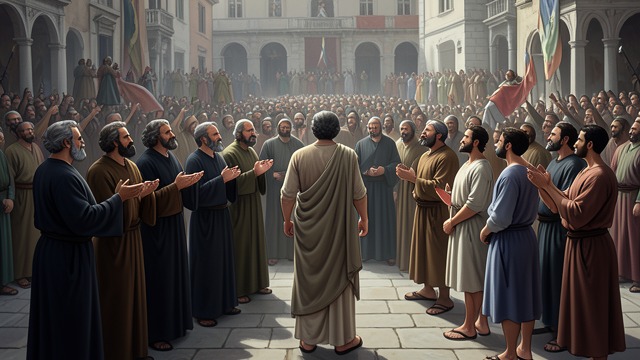
The Question at Dijon
A Public Challenge
The Academy asks whether the restoration of arts and sciences has purified morals. Rousseau takes the question as an occasion to challenge the prestige of learning.
An Unexpected Answer
He argues that refinement may disguise rather than remedy social corruption. The essay’s provocative stance brings him public attention.
Refinement Conceals Character

Refinement Conceals Character
Polished Appearances
Rousseau portrays politeness and fashion as a uniform surface that makes people difficult to know. Social performance replaces candid expression.
Trust Erodes
Under the veneer, he sees suspicion, jealousy, and fraud. Refinement matters politically because it weakens the trust on which civic life depends.
Ancient Examples Invoked
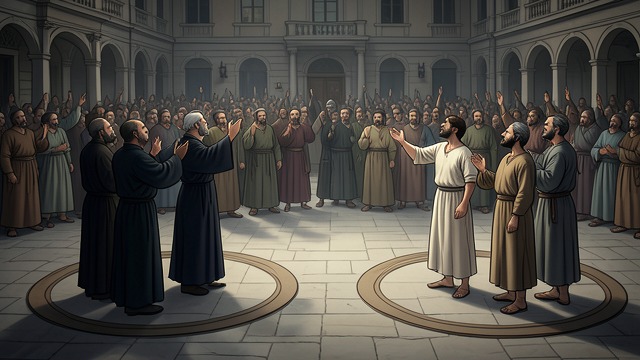
Ancient Examples Invoked
Contrasting Reputations
Rousseau sets Athens, renowned for arts and eloquence, against Sparta’s austere civic discipline. The contrast dramatizes his suspicion of cultural achievement.
Polemical History
These examples function as arguments about virtue and public character rather than balanced historical portraits. Their force depends on the moral contrast he draws.
Knowledge’s Origins Questioned

Knowledge’s Origins Questioned
Vices as Sources
Rousseau links astronomy, eloquence, geometry, and other studies to superstition, ambition, avarice, or pride. He challenges the idea that learning springs from virtue.
Social Costs
Learning can consume time and encourage luxury, while honors reward cleverness more readily than good conduct. The critique is aimed at a culture’s priorities, not merely its scholars.
A Provocation Becomes a Reputation
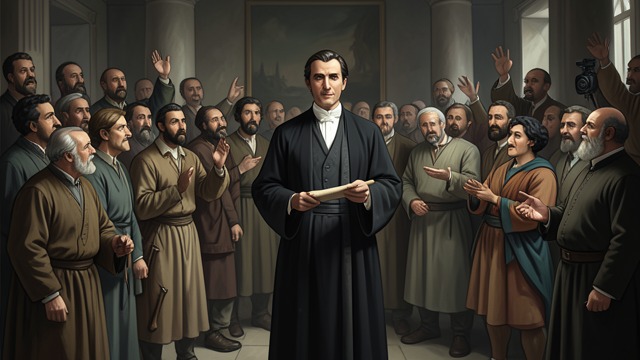
A Provocation Becomes a Reputation
Success and Resistance
The prize-winning essay makes Rousseau famous and prompts replies from writers and scholars, including Voltaire and d’Alembert.
A Starting Point, Not a Final System
The introduction treats the work as rhetorically powerful but limited in argument. Its lasting importance is its place in Rousseau’s development toward political theory.
1750, when the Academy of Dijon announces its prize
1750, in the Discourse’s first part
1750, as Rousseau compares Athens and Sparta
1750, in the second part of the Discourse
After the essay’s 1750 publication
